Summer Event Season Special Offers. Click here


Gazebo Wind Ratings Explained: Choosing a Gazebo for Wellington's Notorious Weather
Ask anyone who’s tried to run a market stall in Wellington on a typical Saturday, and they’ll tell you the same thing. It’s not the rain that gets you. It’s the wind.
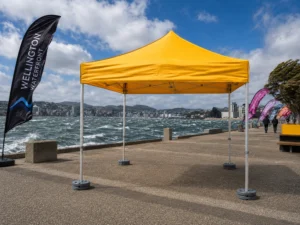
Wellington is genuinely, statistically one of New Zealand’s windiest cities. The Cook Strait funnels air directly into the region, and the surrounding terrain can channel and intensify winds in exposed locations. What that means practically is that a gazebo that performs perfectly well in Auckland or Christchurch might be a completely different story on Wellington’s waterfront, or at a sports ground in the Hutt Valley, or anywhere exposed and south-facing.
So if you’re buying a gazebo for Wellington, or anywhere else in New Zealand where the wind is a real consideration, here’s what you actually need to know.
What Wind Ratings Actually Mean
Wind rating numbers get thrown around in gazebo marketing without much explanation of what they refer to. Let’s clear that up.
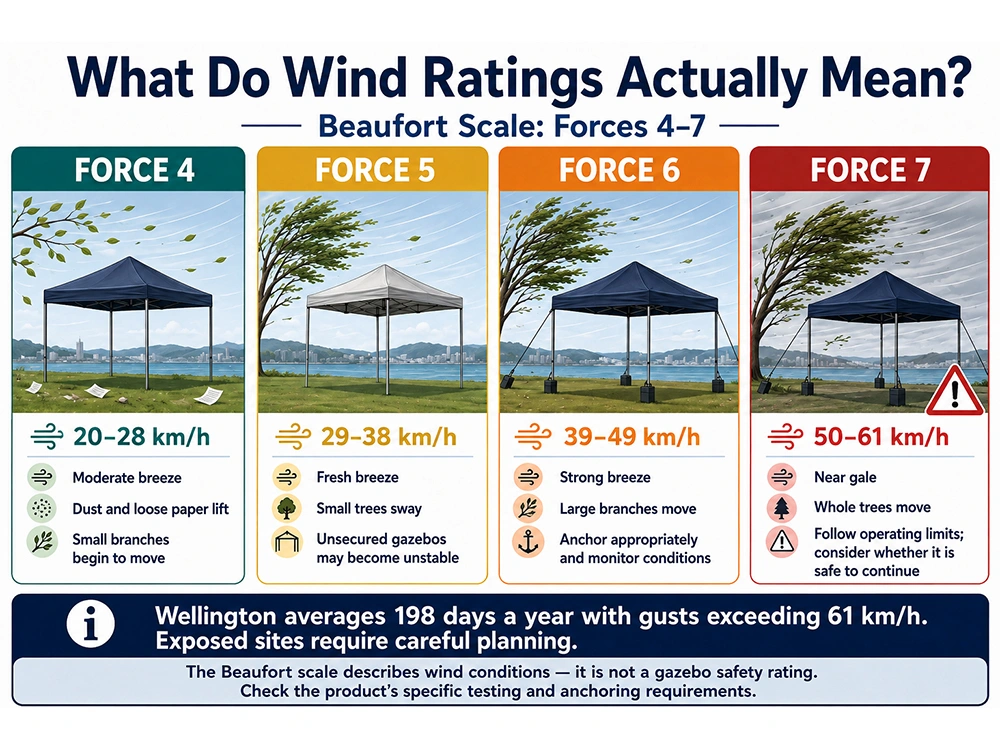
Wind speeds may be stated in kilometres per hour, while the Beaufort scale provides a practical way to understand what different conditions feel like. However, the Beaufort scale is not a gazebo safety rating, and any product rating should be checked against its specific testing and anchoring requirements.
 Force 4 (20–28 km/h): A moderate breeze. Dust and loose paper lift, and small branches begin to move.
- Force 5 (29–38 km/h): A fresh breeze. Small trees sway, and unsecured gazebos may become unstable.
- Force 6 (39–49 km/h): A strong breeze. Large branches move, and umbrellas become difficult to use. Gazebos require appropriate anchoring, and conditions should be monitored closely.
- Force 7 (50–61 km/h): A near gale. Whole trees move, and walking against the wind becomes difficult. At this level, event organisers should follow the manufacturer’s operating limits and consider whether it is safe to continue.
 Force 4 (20–28 km/h): A moderate breeze. Dust and loose paper lift, and small branches begin to move.
Strong winds are a routine consideration in Wellington. NIWA reports that the city experiences an average of 198 days a year with gusts exceeding 61 km/h. Conditions vary by location, but exposed sites such as the south coast, waterfront, hilltop venues and open sports grounds require particularly careful planning.
The Problem With 'Wind Resistant' Claims
Here’s something worth knowing before you shop. The words ‘wind resistant’ do not tell you how a gazebo was assessed, what wind speed it was assessed for, or how it was anchored at the time. On their own, they provide very little useful information about how the frame may perform in real conditions.
A certified wind rating should be more specific. It should identify the model and size covered, the applicable engineering or testing standard, and the setup and anchoring conditions used in the assessment. Where a Hercules gazebo carries a certified wind rating, the supporting information is model-specific, so check the relevant specification rather than assuming one rating applies across the entire range.
For anyone running an event where staff, customers or members of the public will be using the shelter, this distinction goes beyond product quality. The rating, anchoring instructions and safe operating limits all need to be understood before the gazebo is used.
Frame Strength: What Wellington Conditions Actually Need
Wind doesn’t just push sideways on your gazebo. It also creates lift. That upward force works alongside the lateral pressure on the frame, putting stress on the canopy, joints, connectors and anchoring system.
That’s why thin-walled frames struggle in wind—not always because they snap, but because the legs and trusses flex, connectors work loose, and the frame begins to rack and twist under changing loads. Once that happens, it becomes harder to control and more vulnerable to the next gust.
What a Wellington environment specifically needs from a frame:
- A frame profile of at least 40mm. Based on our experience supplying gazebos for regular commercial use, this is the minimum we generally recommend for Wellington conditions. Leg width isn’t the only factor, though. Wall thickness, aluminium grade, frame geometry, span, connectors and truss design all contribute to overall strength.
- Reinforced connectors that lock securely and stay locked under load, not just when you test them in a car park.
- A canopy that fits properly and stays taut. Loose or poorly tensioned fabric can flap heavily, catch the wind and place additional stress on the frame.
- Proper anchoring. No frame, regardless of how strong it is, can perform safely without being anchored correctly.
Anchoring: The Part That Gets Skipped
You can have the strongest commercial frame in the range and still end up with a dangerous setup if the anchoring isn’t right. In Wellington especially, this isn’t optional.
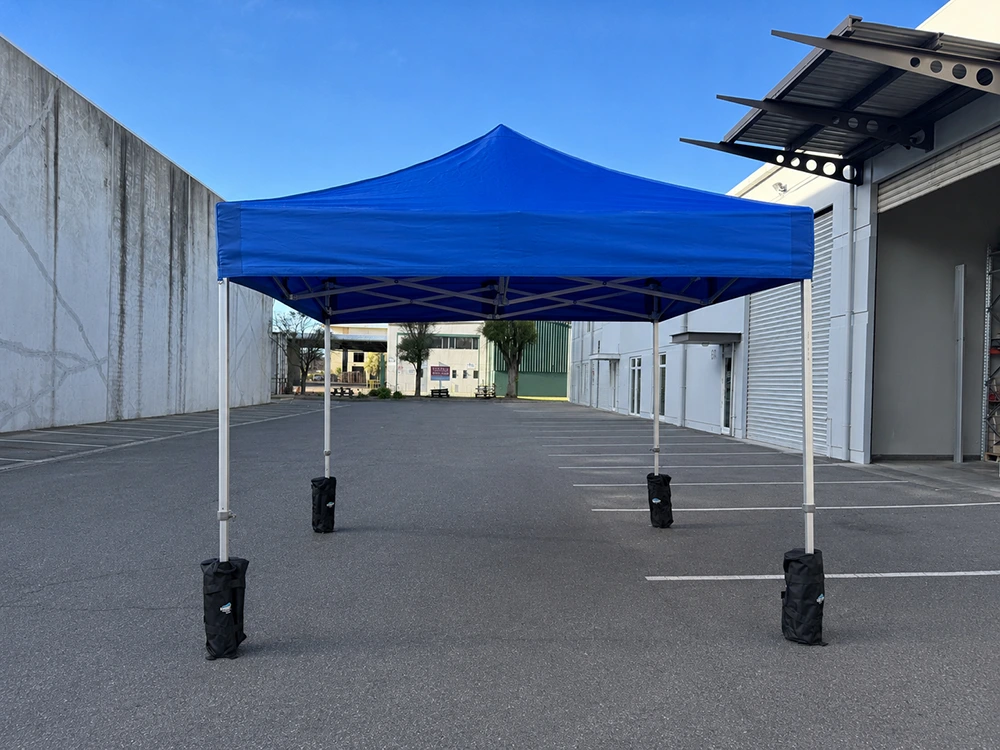
On hard surfaces where pegs aren’t an option, every leg needs to be weighted evenly. Weight bags are a practical option at approximately 21kg each when filled. Where possible, we recommend steel gazebo weight plates. They sit securely around the legs and can be stacked when more weight is needed, while sandbags are generally limited to one per leg.
| Gazebo size | Number of legs | Weight bags | Steel leg weights |
| 2 × 2m, 2.5 × 2.5m, 3 × 3m, 3 × 4.5m, 4 × 4m and 4 × 6m | 4 | 4 × approximately 21kg—one per leg | 8—two per leg |
| 3 × 6m and 4 × 8m | 6, including middle legs | 6 × approximately 21kg—one per leg | 12—two per leg |
On grass or soft ground, combine pegs and weight bags rather than choosing between them. In high-wind conditions, pegs alone can pull out of soft ground under sustained upward force. Weight bags alone can shift if the frame starts to move. Together they work.
Guy ropes attached to fixed points add a third layer for the most exposed sites. Waterfront events, hilltop venues, open fields; if you’re setting up somewhere genuinely exposed, this is worth doing.
Sidewalls need careful thought. They can catch the wind and increase pressure on the frame, especially when only some sides are enclosed. Follow the setup guidance for your model, monitor the conditions and pack down if the weather becomes unsafe.
Which Models Are Actually Built for Wellington
Not every Hercules model is equally suited to Wellington’s conditions, and we’d rather tell you that straight than let you buy something that doesn’t match the environment.
The HEX 45A is a strong starting point for Wellington users. The hexagonal frame geometry adds torsional rigidity that a rectangular frame doesn’t have, which helps it resist crosswinds and shifting wind direction. The 45mm aluminium frame delivers commercial-grade strength at a portable weight.
The Pro 40 steps up for more demanding professional commercial use. The 40mm rectangular aluminium frame with reinforced connectors is built for users who need consistent performance in variable conditions across multiple setups every week.
The Pro 57 is the strongest aluminium frame in the range and the right choice for frequent commercial use in Wellington’s most exposed locations. The 57mm aluminium tubing with thick walls gives it a rigidity that you feel immediately when you set it up. In Wellington conditions, that weight works in your favour.
Before choosing a model, check the certified rating and anchoring requirements for the exact gazebo size and configuration you intend to use. A rating for one size or setup should not automatically be applied to another.
What Wellington Users Actually Report
The feedback we hear most often from Wellington customers is that frame quality and proper anchoring make a noticeable difference. A more substantial commercial frame is less prone to movement and flexing than a lightweight budget gazebo, particularly during regular use in exposed locations.
Some long-term market vendors also tell us that investing in a commercial frame has reduced the need to replace damaged budget gazebos. The right choice still depends on the location, frequency of use, gazebo size and anchoring setup, so we recommend looking beyond the initial purchase price and considering the full working life of the frame.
The key phrase is properly anchored. Even the strongest frame can become a hazard without the correct anchoring, and no gazebo can withstand every possible weather condition. A certified wind rating applies only under its stated assessment and setup conditions; it is not a guarantee of safety in every location or weather event.
Extreme weather can arrive quickly and unpredictably. If severe weather is forecast, the manufacturer’s operating limit is being approached, or conditions begin to deteriorate, follow your event safety plan and pack down the gazebo when it is safe to do so. Do not rely on the frame or anchoring system to resist unsafe conditions.
With appropriate anchoring, responsible use and sensible judgement, the right commercial frame can perform reliably in Wellington’s demanding environment.
If you want to see the HEX 45A, Pro 40, and Pro 57 in person before deciding, visit our Wellington store in Lower Hutt. Our team knows Wellington conditions firsthand and can help you work out exactly what setup makes sense for your location, your events, and how you’re planning to anchor. No guesswork, just a straight conversation about what will actually hold up.